


Setting Consulting Rates for IT Professionals in Canada and USA 2025

Updated: Aug 6, 2025

Setting consulting rates in IT is getting more complicated every year. In 2025, IT consultants in Toronto are charging up to 40 percent more than in smaller Canadian cities. That might sound like market chaos in action. But the real shock is that most consultants are still leaving money on the table by undervaluing their expertise and ignoring the power of value-based pricing.
Table of Contents
Quick Summary
Takeaway | Explanation |
Understand key factors in rate setting | Rates depend on expertise, demand, project complexity, and geographical location. Consider these to accurately reflect your value. |
Adopt value-based pricing strategies | Base your fees on the perceived value delivered to clients, not just time spent. This emphasizes the strategic impact of your services. |
Prepare thoroughly for negotiations | Research market rates and have documented evidence of past successes. This builds confidence in your proposed rates and professionalism. |
Avoid undervaluing your expertise | Setting low rates can harm your perceived value and client attraction. Price based on your expertise and the business impact you can deliver. |
Maintain consistent pricing strategies | Develop a structured approach that reflects your professional growth and market demands, enhancing your credibility with clients. |
Key Factors Influencing Consulting Rates
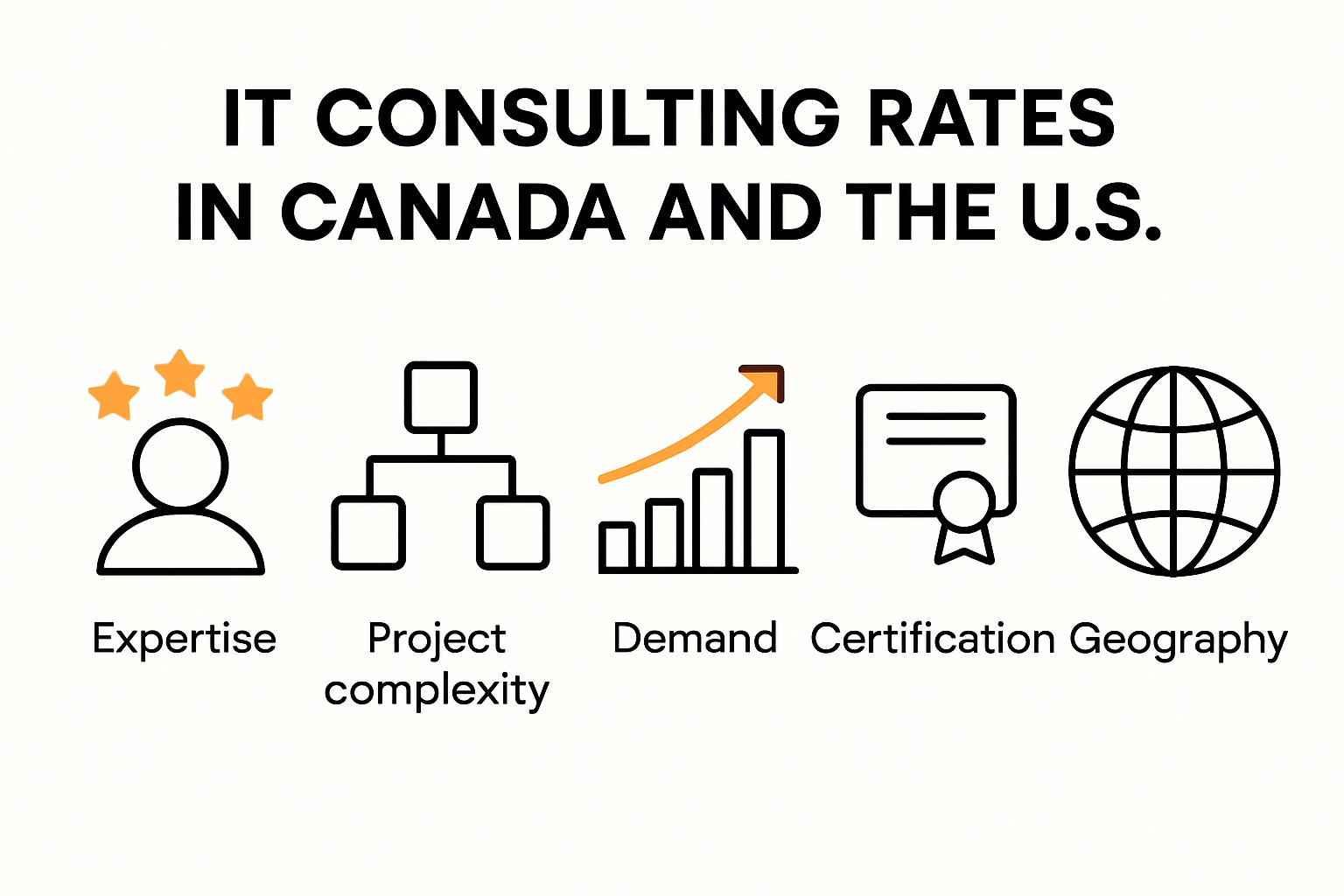
Consulting rates for IT professionals are not arbitrary numbers but carefully calculated values shaped by multiple interconnected dynamics. Understanding these key factors becomes critical when setting consulting rates that reflect true professional value and market positioning.
Professional Expertise and Market Demand
Research from Monadnock Consulting Studies reveals ten critical dynamics influencing advisory service rates, with competence and market demand standing prominently among them. Consultants with specialized skills in emerging technologies like cloud computing, cybersecurity, or artificial intelligence can command significantly higher rates compared to generalist practitioners.
Experience plays a pivotal role in rate determination. Senior IT professionals with demonstrable track records of successful project implementations and complex problem solving can justify premium consulting fees. Clients are willing to invest more when consultants bring proven expertise that directly translates into tangible business outcomes.
Project Complexity and Risk Assessment
According to industry analysis from Simpli Consulting Insights, project scope and complexity are fundamental rate determinants. High stakes enterprise transformation projects involving intricate technological integrations naturally demand higher compensation compared to straightforward implementation tasks.
Risk assessment becomes another crucial factor. Consultants working in domains with significant technological uncertainty or potential substantial financial implications warrant higher rates. Cybersecurity consulting, for instance, involves protecting critical infrastructure and mitigating potential multi million dollar breach risks. This inherent complexity and potential liability directly influence rate structures.
Geographic and Professional Credentials
Insights from Accounting Professional Research highlight how geographic location and professional credentials substantially impact consulting rates. IT professionals in major technological hubs like Toronto, Vancouver, San Francisco, and New York typically command higher rates due to concentrated market demand and higher living costs.
Professional certifications from recognized institutions provide additional rate justification. Credentials from Microsoft, Cisco, AWS, or specialized security certification bodies demonstrate a commitment to continuous learning and validate technical expertise. These credentials serve as tangible proof of a consultant’s capabilities, enabling more confident rate negotiations.
Navigating these interconnected factors requires strategic thinking. Successful IT consultants continuously assess market trends, upgrade their skill sets, and position themselves as valuable problem solvers rather than mere service providers. Read our comprehensive guide on crafting your consulting strategy to understand how these dynamics translate into practical rate setting approaches.
Before diving into subsequent sections, here is a summary table to help clarify the primary factors influencing consulting rates in IT, as described above.
Factor | Description | Impact on Rates |
Professional Expertise | Specialized skills & proven experience | Higher expertise = higher rates |
Market Demand | Demand for certain IT specialties | High demand drives rates up |
Project Complexity | Scope, scale, and criticality of the project | Complex projects command premiums |
Risk Assessment | Degree of technological & financial risk involved | High risk increases compensation |
Geographic Location | Major tech hubs vs. smaller cities | Hubs like Toronto = higher rates |
Professional Credentials | Certifications from leading companies/institutions | Credentials = rate justification |
Effective Pricing Models for IT Consultants
Navigating pricing strategies represents a critical challenge for IT consultants seeking sustainable and profitable business models. The right pricing approach can differentiate a consultant from competitors while ensuring fair compensation for specialized expertise.
Value-Based Pricing Strategies
According to research on pricing methodologies, value-based pricing emerges as a sophisticated approach where fees are determined by the perceived value delivered to the client rather than traditional hourly or project-based calculations. This model requires deep understanding of client needs and the potential business impact of technological solutions.
Under value-based pricing, IT consultants assess the potential financial benefits their services will generate. For instance, a cybersecurity consulting project that prevents a potential data breach worth millions of dollars can justify a significantly higher fee compared to a standard hourly rate. This approach shifts the conversation from cost to strategic investment, positioning the consultant as a strategic partner rather than a mere service provider.
Flexible Pricing Structures
Modern IT consulting demands flexible pricing models that accommodate diverse client requirements. Hybrid approaches combining fixed project fees, retainer arrangements, and performance-based compensation provide adaptability. Performance-based models, where a portion of consultant compensation is tied to measurable project outcomes, can build client trust and demonstrate confidence in delivered results.
Government consulting trends offer interesting insights into pricing innovation. Financial Times research highlights how consulting firms are increasingly adopting performance-linked fee structures, particularly in government contracts. This trend suggests a broader industry movement towards demonstrating tangible value and accountability.
Transparent Pricing Communication
Effective pricing goes beyond mathematical calculations. Transparent communication about pricing models, expected deliverables, and potential client benefits becomes crucial. IT consultants must articulate the unique value proposition, breaking down complex technological solutions into clear, understandable business advantages.
Pricing communication should address potential client concerns proactively. This includes providing detailed scope definitions, potential risk mitigations, and clear explanation of how proposed solutions align with client strategic objectives. Learn more about crafting compelling consulting proposals to master this critical skill.
Successful IT consultants recognize that pricing is not just about numbers but about building trust, demonstrating expertise, and creating measurable client value. By adopting sophisticated, client-centric pricing models, consultants can differentiate themselves in a competitive marketplace and build long-term, mutually beneficial professional relationships.
To help visualize the different pricing models and their characteristics, the following table compares typical approaches discussed in this section.
Pricing Model | Description | Key Advantages |
Hourly Rate | Fixed price per hour worked | Simple, transparent |
Project-Based Fee | Flat fee for the entire project | Predictable costs, scope clarity |
Value-Based Pricing | Fee based on value delivered to client | Rewards impact, higher earning |
Retainer Arrangement | Ongoing monthly/periodic payment for ongoing services | Revenue stability, relationship |
Performance-Based Model | Portion of fee tied to agreed project outcomes | Builds trust, aligns incentives |
Hybrid Approach | Mix of two or more models (e.g., retainer + performance) | Flexibility, adaptability |
Best Practices for Negotiating Rates in 2025
Rate negotiation represents a nuanced art for IT consultants, requiring strategic preparation, clear communication, and a deep understanding of market dynamics. Successful negotiations go beyond mere monetary transactions and encompass establishing long-term professional relationships built on mutual respect and perceived value.
Market Research and Preparation
According to research from SpendEdge, conducting thorough market research is essential before entering any negotiation. IT professionals must develop a comprehensive understanding of current market rates, industry standards, and the specific value their unique skill set brings to potential clients.
Preparing a detailed portfolio that showcases previous successful projects, quantifiable outcomes, and specific technological expertise becomes crucial. This documentation serves as tangible evidence supporting proposed rates. Consultants should compile case studies demonstrating measurable business impacts, such as cost savings, efficiency improvements, or revenue generation resulting from their previous engagements.
Strategic Negotiation Techniques
Insights from GP IT Tech USA recommend creating a competitive negotiation environment by presenting multiple proposal options. This approach allows potential clients to understand the range of services and associated values while providing flexibility in rate structures.
Effective negotiators understand the importance of presenting multiple pricing models. These might include hourly rates, project-based fees, retainer arrangements, and performance-linked compensation. Each model presents unique advantages, and the ability to articulate these benefits demonstrates professional sophistication.
Establishing Long-Term Value Propositions
LinkedIn professional advice highlights the significance of moving beyond transactional interactions. Successful rate negotiations focus on establishing long-term partnerships rather than securing short-term financial gains.
Consultants should frame discussions around the comprehensive value they provide. This involves clearly communicating how their expertise translates into tangible business outcomes, risk mitigation, and strategic technological advancement. Demonstrating an understanding of the client’s broader business objectives positions the consultant as a strategic partner rather than a mere service provider.
Learn advanced negotiation strategies for IT consultants to refine your approach and maximize your professional potential.
Ultimately, rate negotiation in 2025 demands a holistic approach. IT consultants must combine technical expertise, market awareness, strategic communication, and a client-centric mindset to successfully navigate complex negotiation landscapes. By presenting clear, value-driven propositions and maintaining professional integrity, consultants can establish mutually beneficial relationships that extend far beyond initial contract discussions.
Common Mistakes to Avoid When Setting Consulting Rates
Setting consulting rates is a complex process fraught with potential pitfalls that can undermine a professional’s earning potential and market positioning. Understanding and avoiding these common mistakes becomes crucial for IT consultants seeking sustainable and profitable careers.
Undervaluing Professional Expertise
One of the most critical errors IT consultants make is significantly undervaluing their professional capabilities. Many professionals, especially those early in their consulting journey, fall into the trap of pricing their services too low, mistakenly believing that lower rates will attract more clients.
Research from Professional Pricing Strategies reveals that underpricing can have detrimental long-term consequences. Low rates not only diminish perceived professional value but also attract clients who may not appreciate the depth of expertise required for complex technological solutions. Clients often associate pricing with quality, and rates that are too low can signal inexperience or lack of specialized skills.
Consultants must recognize that their rates should reflect not just time spent, but the cumulative value of their expertise, years of experience, specialized knowledge, and potential business impact. This means considering the comprehensive value proposition beyond mere hourly engagement.
Inconsistent Pricing Strategies
Inconsistent pricing approaches represent another significant mistake in the consulting landscape. This inconsistency can manifest in various ways: fluctuating rates across different projects, failing to adjust pricing with increasing expertise, or applying random pricing without a strategic framework.
Industry Analysis from Tech Consulting Insights suggests that successful consultants develop a consistent, transparent pricing methodology. This involves creating a structured approach that accounts for project complexity, required expertise, potential client value, and market rates. Inconsistent pricing can confuse potential clients and undermine professional credibility.
Developing a clear, scalable pricing strategy requires regular market research, continuous skill assessment, and a willingness to adjust rates as professional capabilities evolve. Consultants should view pricing as a dynamic process that reflects their growing expertise and changing market demands.
Neglecting Cost of Business and Personal Sustainability
Many IT consultants overlook the comprehensive financial considerations required for sustainable business operations. This mistake involves failing to account for indirect costs such as healthcare, retirement planning, business infrastructure, continuous learning, and potential periods without client engagement.
Financial Planning for Independent Professionals emphasizes the importance of holistic financial planning. Consultants must calculate rates that not only cover direct project costs but also provide sufficient buffer for business overhead, professional development, and personal financial security.
Explore our comprehensive guide to sustainable consulting rates to develop a robust financial strategy.
Successful IT consulting in 2025 demands a sophisticated approach to rate setting. By avoiding these common mistakes, professionals can create a pricing strategy that reflects their true value, attracts high-quality clients, and supports long-term career sustainability. The key lies in continuous learning, strategic thinking, and a commitment to delivering exceptional value.
Below is a summary table outlining the most common mistakes made in consulting rate setting and their potential consequences.
Mistake | Description | Potential Consequence |
Undervaluing Professional Expertise | Setting rates too low for skill level & experience | Perceived as low value, miss clients |
Inconsistent Pricing Strategies | Varying rates without strategy, neglecting skill/market change | Client confusion, credibility loss |
Neglecting Cost of Business & Sustainability | Failing to factor in overheads, downtime, personal financial needs | Unsustainable business, low profit |

Frequently Asked Questions
What factors influence consulting rates for IT professionals?
Consulting rates for IT professionals are influenced by several key factors including professional expertise, market demand, project complexity, geographic location, and professional credentials. Higher expertise and demand typically lead to higher rates.
How can IT consultants adopt value-based pricing strategies?
IT consultants can implement value-based pricing by assessing the perceived value their services deliver to clients rather than charging based on time spent. This involves understanding the financial benefits their expertise brings, making them valuable partners rather than just service providers.
What are the common mistakes to avoid when setting consulting rates?
Common mistakes include undervaluing professional expertise, creating inconsistent pricing strategies, and neglecting the costs associated with running a sustainable consulting business. Avoiding these can help consultants optimize their rates and attract better clients.
What best practices should IT consultants follow for negotiating rates?
Best practices for negotiating rates include conducting thorough market research, preparing a strong portfolio that showcases past successes, and establishing long-term value propositions to emphasize the impact of their services on the client’s business.
Ready to Set Consulting Rates that Truly Reflect Your Value?
If you find yourself struggling with complex rate decisions, worried about undervaluing your IT expertise, or unsure how to navigate pricing strategies in an unpredictable Canadian or US market, you are not alone. Many professionals hesitate to charge what they are worth because they lack proven frameworks or worry about common mistakes like inconsistent pricing and missing out on value-based approaches. The article showed that these traps keep consultants from building a business with true freedom and income.

You do not have to figure this out on your own. The Consultant’s Compass offers practical tools, rate calculators, and expert mentorship designed exactly for IT professionals ready to take control of their consulting journey. Visit The Consultant’s Compass to access real-world guides that help you master value-based pricing as discussed in the article. Get started today and avoid the costly mistakes many new consultants make. Check out the bestselling guide and bonuses and join a community that supports your growth from day one. Act now, so your next client sees the true value you deliver.
Recommended
Comments